
Objects, considered.
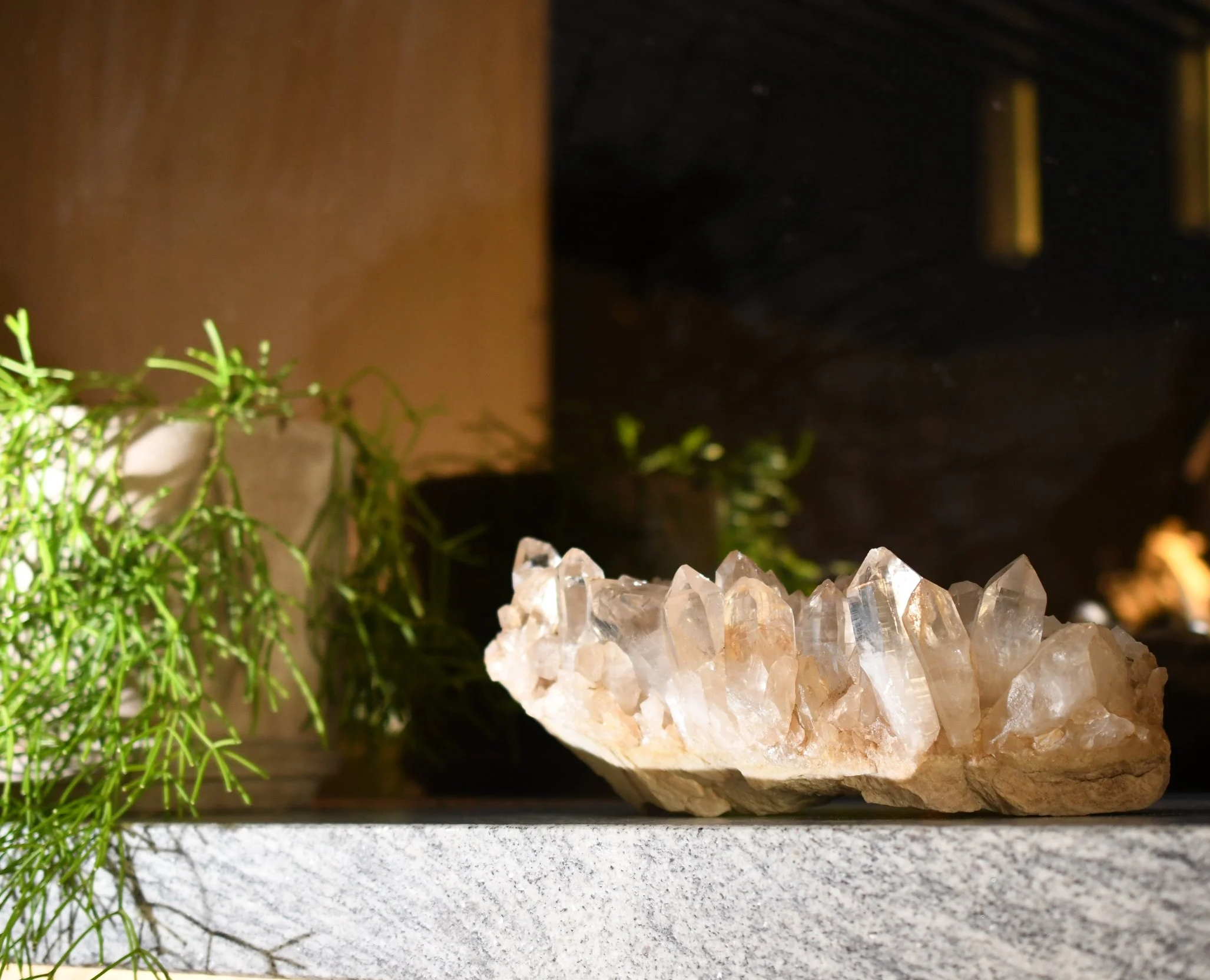
-
Dimensions are approximate and measured at the widest, highest or deepest points of each object.
Due to their irregular natural form, measurements are rounded to the nearest 5 mm and may vary slightly depending on where the piece is measured.
-
Handle with care and support the object from its most substantial area.
Where practical, use a clean, soft cloth when lifting or repositioning your piece. Avoid lifting from delicate crystal points, edges or projecting formations.
-
Some crystalline formations may naturally release small particles or fragments, particularly when first unpacked or when handled.
This is a normal characteristic of certain minerals. Avoid brushing, rubbing or picking at delicate crystalline surfaces.
A small amount of mineral dust or tiny fragments may occasionally be present after transport. This can occur naturally with crystalline materials and does not necessarily indicate damage. -
Always place your object gently rather than sliding it across a surface.
Natural stone and crystal may have sharp or uneven bases that can mark timber, stone, marble, glass or other finished surfaces.
Crystals and mineral formations are often dense and heavier than they appear. Before placing your piece on shelving, cabinetry or furniture, please ensure the surface is stable, properly supported and suitable for the weight of the object.Ensure the object is positioned securely on a stable, level surface.
-
We recommend using small rubber or felt bump-ons beneath the object to help protect timber, stone, glass and other finished surfaces.
We’ve found that the adhesive on bump-ons does not adhere securely to natural mineral surfaces. A small amount of Blu Tack can be used to hold it in place. Use only enough to secure the protector.
-
For general care, remove dust gently with a soft, dry cloth or very soft brush.
Avoid abrasive cleaners, household chemicals and vigorous rubbing. As different minerals react differently to water and cleaning products, we do not recommend immersing your piece or applying liquids unless you know they are suitable for that specific mineral.
Please note that some crystal formations like celestine, due to their chemical makeup, can start to dissolve when exposed to water. Always check online before attempting to use water on any crystal, and try a small section that is not prominent before using it on the whole crystal.
-
We source from various suppliers around the world who are approved to sell crystals and mineral clusters.